
Agentic marketing is the practice of using AI agents that can plan and carry out marketing work toward a goal, with people setting direction and approving the decisions that matter. Where traditional marketing technology waits for someone to press a button, an agentic system notices what changed, works out what to do about it, and proposes or takes the next step.
For marketing leaders, the shift is less about new tools than about a new operating model. This guide explains what agentic marketing is, how it differs from automation and AI assistants, how the systems are built, where they deliver value today, and how to adopt them without losing control of budget or brand.
What is agentic marketing?
Agentic marketing uses autonomous software agents that can perceive what is happening across your marketing data, reason about it against a goal, and act in your marketing systems. A team might give an agent a goal such as “hold acquisition cost under $40 while growing new customers.” The agent watches performance, spots where spend is underperforming, recommends a change, and once a person approves it, makes the change and tracks the result.
Three things separate agentic marketing from earlier waves of martech:
- It is goal-driven. You define outcomes, not step-by-step instructions.
- It works across steps and systems. Agents can gather data, analyze it, draft a plan and execute it, rather than handling a single task.
- It learns from results. Outcomes feed back into the next decision, so recommendations improve over time.
How agentic marketing differs from automation and AI assistants
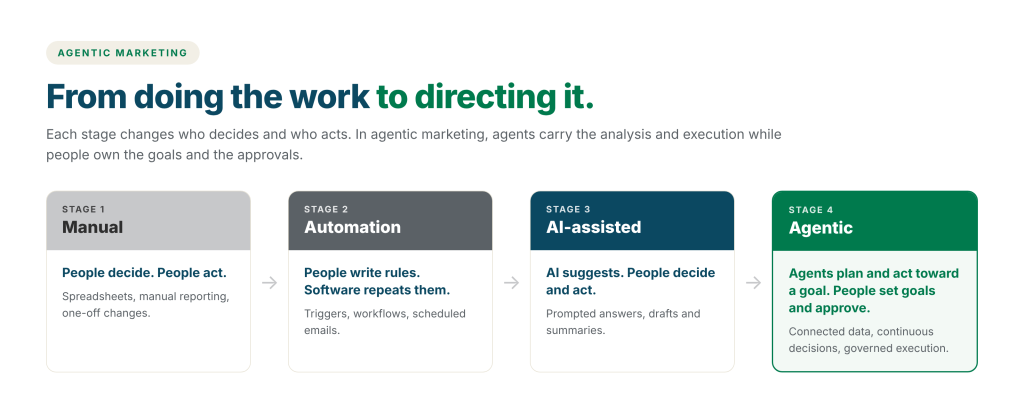
Most marketing teams already use automation and AI assistants. Agentic marketing builds on both, but it changes who does the deciding and who does the acting.
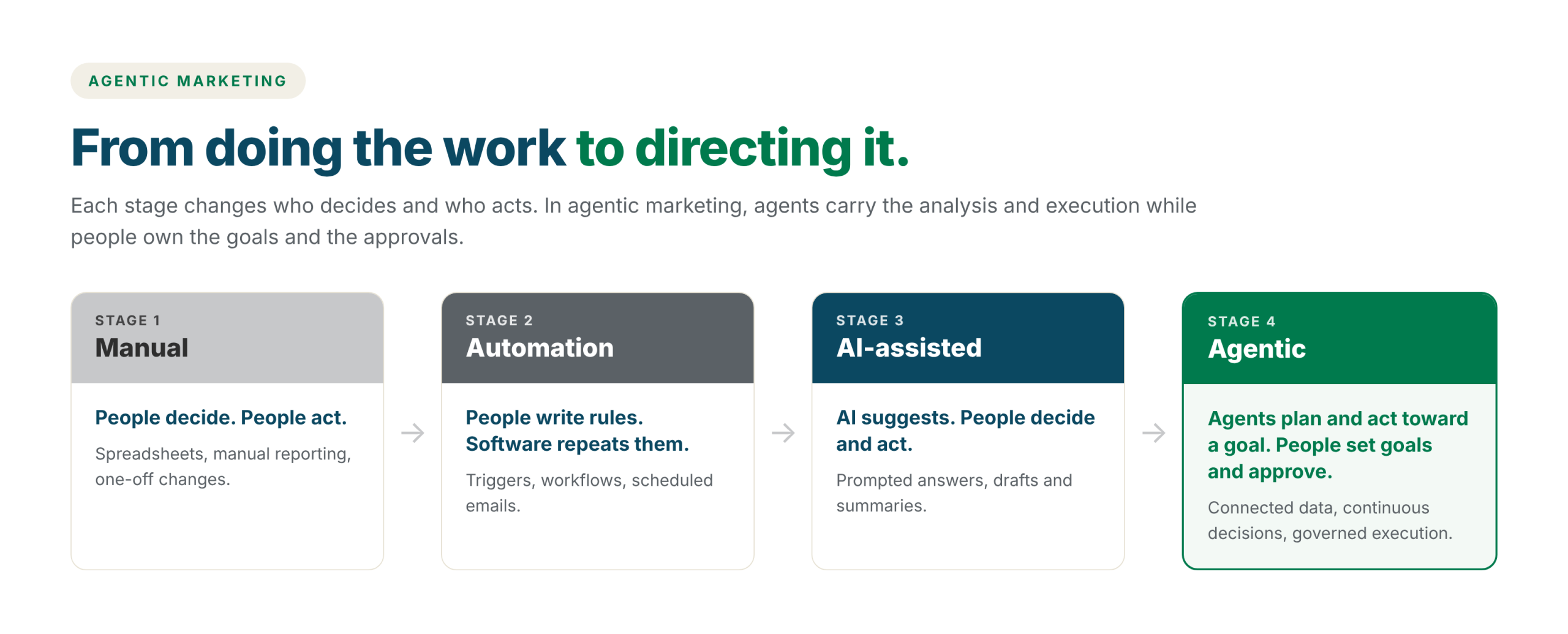
Marketing automation runs the rules a person wrote: send this email when someone downloads that guide. It is reliable, but it only does what it was told, and the rules go stale as the market changes.
AI assistants answer questions and draft content when prompted. They are useful, but they wait for a person to ask, and they usually work only with what someone pastes in.
Agentic systems start from a goal, connect to your data continuously, and take action across steps. People move from doing the work to directing it: setting goals, defining guardrails and approving the moves that carry real risk.
The four layers of an agentic marketing system
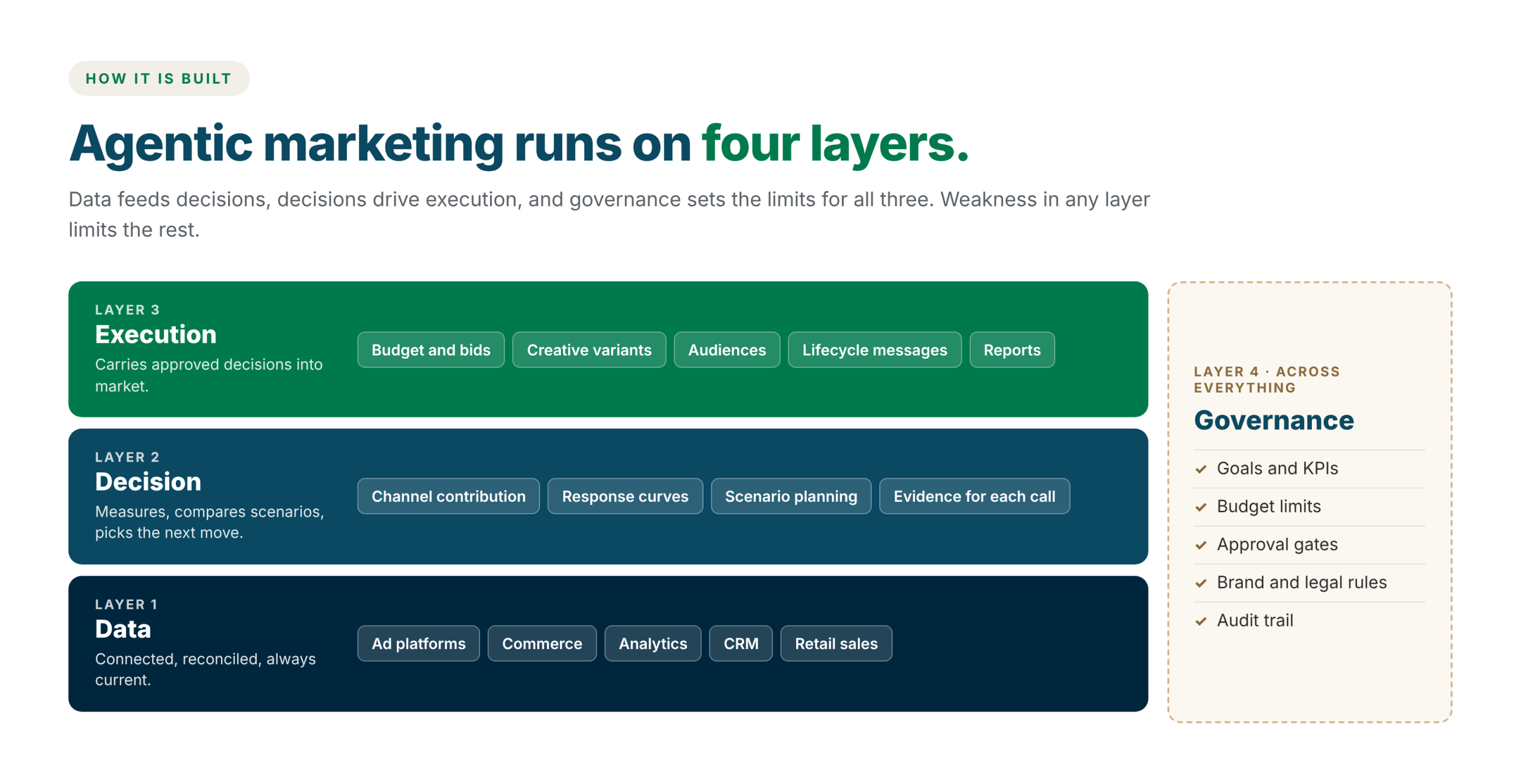
Whatever the vendor, a working agentic marketing setup has the same four layers. Weakness in any one of them limits the rest.
1. Data layer
Agents are only as good as the data they can see. That means connections to ad platforms, commerce, web analytics, CRM and, for brands sold in stores, retail sales data. An agent that only sees one platform will optimize that platform, not the business.
2. Decision layer
This is where the agent reasons: measuring what each channel contributes, comparing scenarios and choosing the best next move. Strong decision layers ground recommendations in statistical models built on your own numbers rather than general knowledge, and they show the evidence behind each recommendation.
3. Execution layer
Execution agents carry approved decisions into market: adjusting budgets and bids, launching creative variants, updating audiences, triggering lifecycle messages and publishing reports. This is where time savings show up most visibly.
4. Governance layer
Governance sits across everything. It defines the goals agents work toward, the limits they cannot cross, the approval gates for spend and customer-facing work, and the audit trail that records what was changed and why.
Agentic marketing use cases
- Budget reallocation. Shifting spend toward the channels and campaigns where the next dollar earns the most. See our guide to marketing budget allocation.
- Media optimization. Adjusting bids, budgets and pacing within limits you set, and flagging saturation before it wastes spend.
- Competitive and market monitoring. Watching competitor pricing, messaging and share of voice, and alerting the team when something moves.
- Planning and briefs. Turning performance data and audience signals into plans and creative briefs in hours instead of weeks.
- Lifecycle and CRM. Choosing the next message, offer or timing for each customer segment based on behavior.
- Reporting and insight. Explaining what changed, why it changed and what to do about it, instead of delivering another dashboard.
What changes for the marketing team
Agentic marketing does not remove the need for marketers. It changes where their time goes. The manual work of pulling, reconciling and reformatting data shrinks. The judgment work grows: deciding which goals matter, which trade-offs are acceptable and which ideas are worth testing.
New skills become important. Teams need people who can define a goal precisely, set sensible guardrails, read the evidence behind a recommendation and know when to override it. Agencies and execution partners stay central too, because creative ideas, production and specialist channel expertise are still made by people. What changes is that everyone works from the same live view of performance.
How to get started with agentic marketing
- Pick one decision to start with. Monthly budget allocation across your main paid channels is a strong first candidate: it is frequent, measurable and expensive to get wrong.
- Connect the data that decision needs. Ad platforms, commerce and analytics at minimum, plus CRM and retail data if they affect the outcome.
- Set your baseline. Record current planning time, acquisition cost and return on media spend before anything changes.
- Define the guardrails. Agree on spending limits, approval thresholds and who signs off on what.
- Run with a human in the loop, then expand. Review every recommendation at first. Widen the agent’s scope as results are verified against the baseline.
Risks and how to manage them
- Made-up numbers. General AI models can state figures confidently that are not real. Require every recommendation to cite the data behind it.
- Runaway spend. Set hard budget limits and approval thresholds that agents cannot override.
- Brand risk. Keep anything customers will see behind human review.
- Optimizing the wrong thing. An agent pursuing platform ROAS can starve the channels that create demand. Set goals on business outcomes such as revenue, profit and acquisition cost.
- Data security. Understand where your data is processed and whether it is used to train models for other customers.
How Insika approaches agentic marketing
Insika is built around a simple loop: ingest, reason, act. It connects to Shopify, Meta Ads, Google Ads, LinkedIn Ads, TikTok Ads, Google Analytics, HubSpot and retail sales data, models what each channel contributes, and recommends decisions with the evidence behind them. Your team approves what goes live, and results feed back into the next recommendation. We call this role the Agent of Record: the system accountable for the path from data to decision to execution.
GURU Organic Energy used Insika to cut planning cycles by 90% and lift sales by 23%, and ColorTokens reached market 75% faster with a 12% increase in leads. Learn more about how a single agent works in our guide to AI marketing agents, or see the full system on our Why Insika page.
Frequently asked questions
Is agentic marketing the same as marketing automation?
No. Automation follows rules a person wrote. Agentic marketing works toward a goal, decides which steps to take, and adapts based on results, with people approving the decisions that carry risk.
Will agentic marketing replace marketers?
It replaces repetitive data work, not marketing judgment. Strategy, creative ideas, brand decisions and final approval stay with people.
What is the difference between agentic marketing and an AI marketing agent?
Agentic marketing is the operating model. An AI marketing agent is one component of it: a piece of software that pursues a specific goal. Most agentic setups use several agents working from the same data under the same guardrails.
How long does it take to adopt?
A first use case can run within weeks if the data connections are straightforward. Most of the effort goes into connecting data and agreeing on guardrails, not configuring the agents.
Is agentic marketing only for large companies?
No. Smaller teams often benefit most, because agents take on the analysis and coordination work that larger companies hire whole teams to do.
See agentic marketing working on real data: watch the Insika demo or talk to our team.