
Marketing budget allocation is the decision of how to split a fixed budget across channels, campaigns and time periods to produce the most revenue. Most teams make it once a year, adjust it reluctantly each quarter, and defend it with last year’s numbers. The brands that grow efficiently treat it differently: as a decision they revisit continuously, based on where the next dollar will earn the most.
This guide covers the common allocation methods, the one principle that matters most, a repeatable four-step process, and how to present the plan so finance supports it.
Why marketing budget allocation is so hard
Three problems make allocation harder than it looks:
- Every platform grades its own homework. Meta, Google and TikTok each report conversions using their own attribution rules, and the totals usually add up to more sales than you actually made.
- Averages hide the margin. A channel can have a strong average return and still be a poor place for your next dollar, because it is already close to saturation.
- Planning is slow. By the time data is pulled, reconciled and turned into a plan, the market has moved and the plan is already out of date.
Common budget allocation methods, and where they fall short
- Percentage of revenue. Simple and predictable, but it sets the size of the budget, not how to split it.
- Last year plus or minus. Easy to approve and almost guaranteed to repeat last year’s inefficiencies.
- Platform-reported ROAS. Rewards the channels best at claiming credit, which are often the ones closest to the purchase rather than the ones creating demand.
- Objective and task. Starts from goals and works backward to cost. Strong in principle, but it still needs a reliable view of what each channel actually delivers.
- Model-based allocation. Uses marketing mix modeling to estimate each channel’s true contribution and response curve, then distributes budget to maximize total return. This is the approach the rest of this guide builds on.
The principle that matters most: allocate on the next dollar
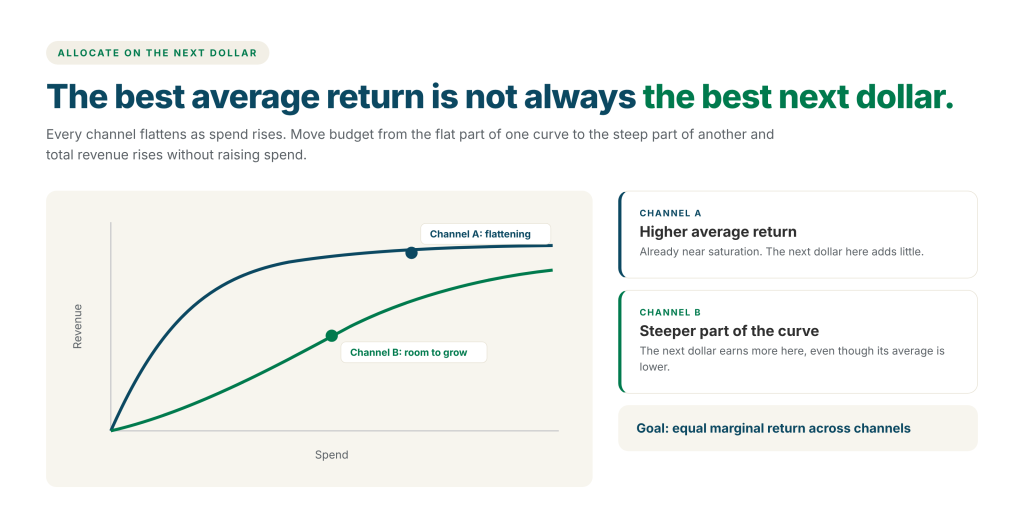
Every channel follows a response curve. Early spend returns a lot. As spend rises, each additional dollar returns less, until the channel is saturated. The question is never “which channel has the best average return?” It is “where does the next dollar return the most?”
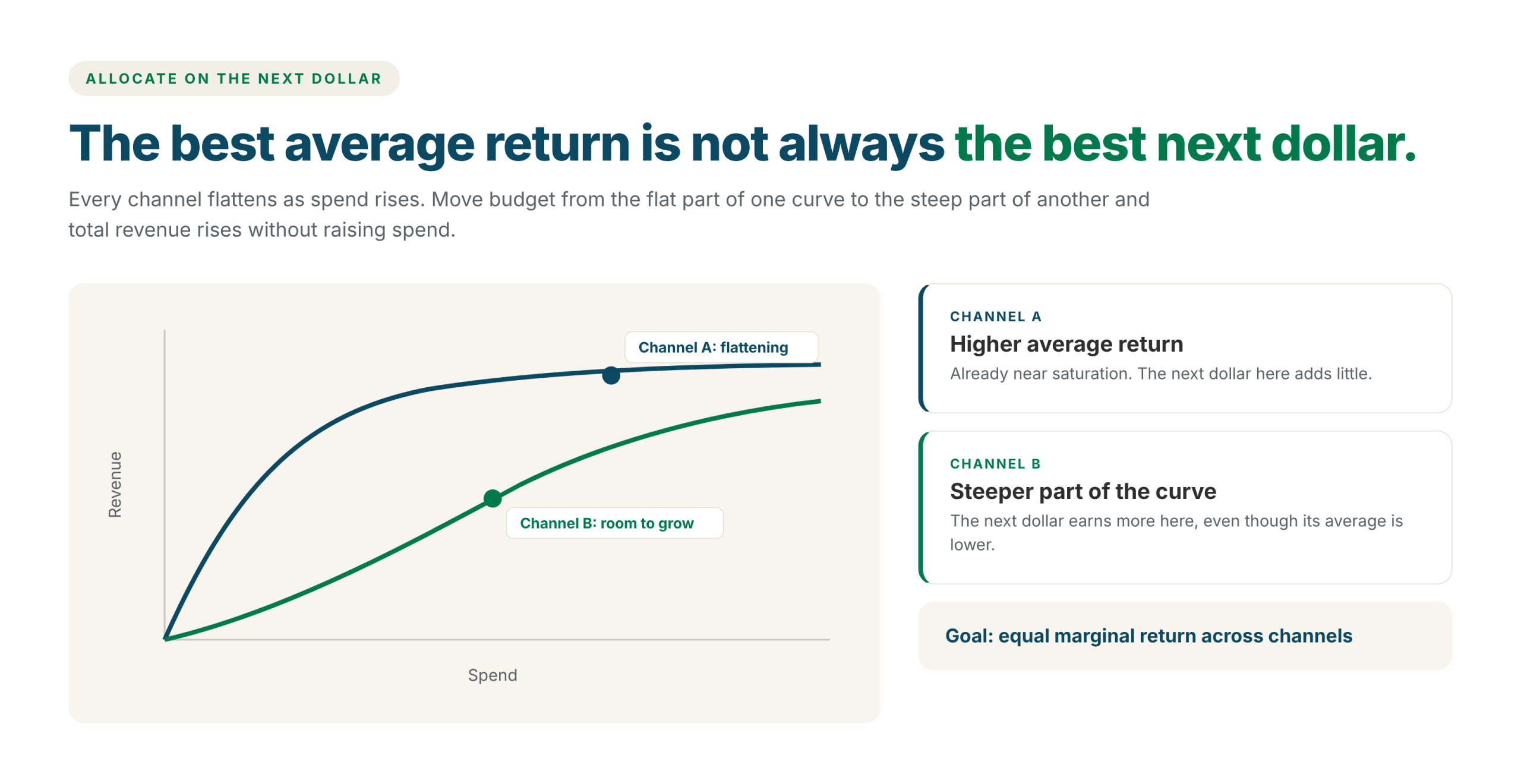
In the example above, Channel A has the higher average return, but it is already flattening. Channel B still has room to grow, so the next dollar earns more there. Moving budget from the flat part of one curve to the steep part of another raises total revenue without raising total spend. A budget is well allocated when the marginal return is roughly equal across channels.
To check whether your own recent spend is still paying back, try our free ROAS calculator, which compares average and marginal ROAS against your break-even.
A four-step process for marketing budget allocation
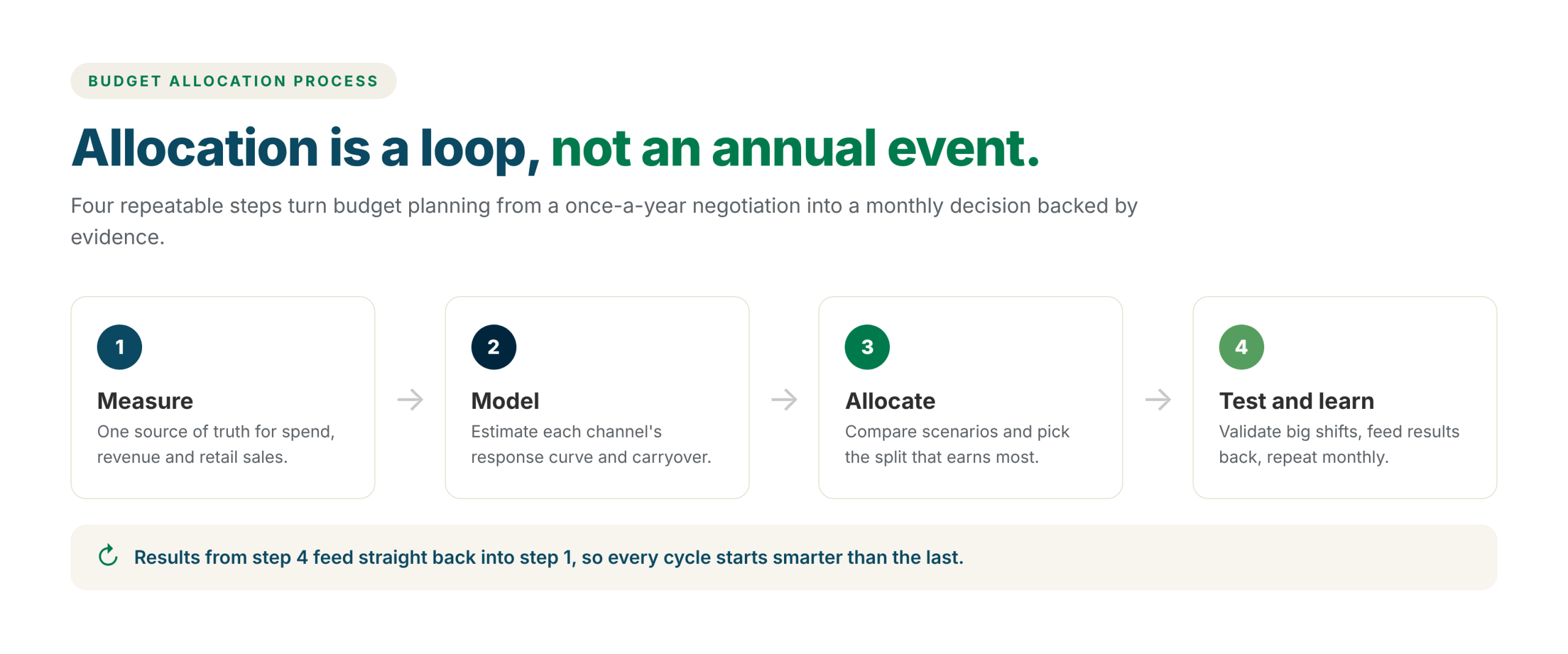
Step 1: Measure on one source of truth
Bring spend, revenue and outside demand drivers into one place, with one definition of revenue that marketing and finance both accept. If your products sell in retail as well as online, include sell-through data, or the plan will undervalue the channels that drive store sales.
Step 2: Model each channel’s response
Estimate how each channel’s revenue responds to spend, including carryover effects and saturation. This is what tells you where the next dollar will work hardest.
Step 3: Allocate with scenarios
Run a few scenarios before committing: the same budget redistributed, a 10% cut, a 10% increase. Showing finance what each option is expected to produce turns a negotiation into a choice between evidence-based options.
Step 4: Test, learn and reallocate
Validate the biggest recommended shifts with holdout or geo tests, feed the results back into the model, and repeat on a monthly or quarterly rhythm. Allocation becomes a loop, not an annual event.
How to get finance on board
- Agree on the baseline first. Record current planning time, blended return on media spend and acquisition cost before anything changes.
- Show ranges, not just point estimates. Finance trusts a plan that is honest about uncertainty.
- Move in steps. Shift a portion of budget, measure, then shift more. Small, verified wins build the credibility for larger moves.
- Report against the baseline on a fixed schedule. Consistency matters more than any single result.
How Insika helps with budget allocation
Insika connects ad platforms, commerce, analytics, CRM and retail sales data, models how each channel responds to spend, and recommends budget shifts with the reasoning behind each one. Your team approves the moves, and Insika can carry approved changes into the ad platforms. GURU Organic Energy saw 90% faster planning cycles and a 23% sales lift, and ColorTokens reached market 75% faster with a 12% increase in leads.
For the broader planning approach, read our AI marketing strategy framework.
Frequently asked questions
How often should you reallocate a marketing budget?
Monthly for brands with significant paid media, quarterly at minimum. Annual-only allocation leaves money in saturated channels for most of the year.
What percentage of revenue should go to marketing?
It varies widely by industry, growth stage and margin structure. Rather than relying on a benchmark, use your own response curves to find the point where additional spend stops paying back.
Should brand and performance budgets be planned separately?
Plan them together. Brand activity often lifts the performance of lower-funnel channels, and a model that sees both can account for that. Planning them in separate silos usually underfunds brand.
Want to see where your next dollar should go? Watch the Insika demo or talk to our team.