
AI agents in marketing have moved from experiment to expectation. Most marketing organizations now use AI, around half of marketers use AI agents at work, and a growing number are building their own tools with models like Claude. The idea is a good one. But in 2026 the “every marketer is a builder” model is running into three limits at once: smaller teams, constant upskilling and maintenance, and the token caps companies such as Uber have started to impose. For most teams, it is neither scalable nor sustainable on its own.
Key takeaways
- About half of marketers already use AI agents, but only 17% have had job-specific training.
- Marketers can now build their own AI tools, and the best examples save hours every week.
- Smaller teams, constant upkeep and new per-employee token caps make do-it-yourself agents hard to sustain.
- The sustainable model: maintained agents for core decisions, homemade tools at the edges.
How quickly are marketing teams adopting AI agents?
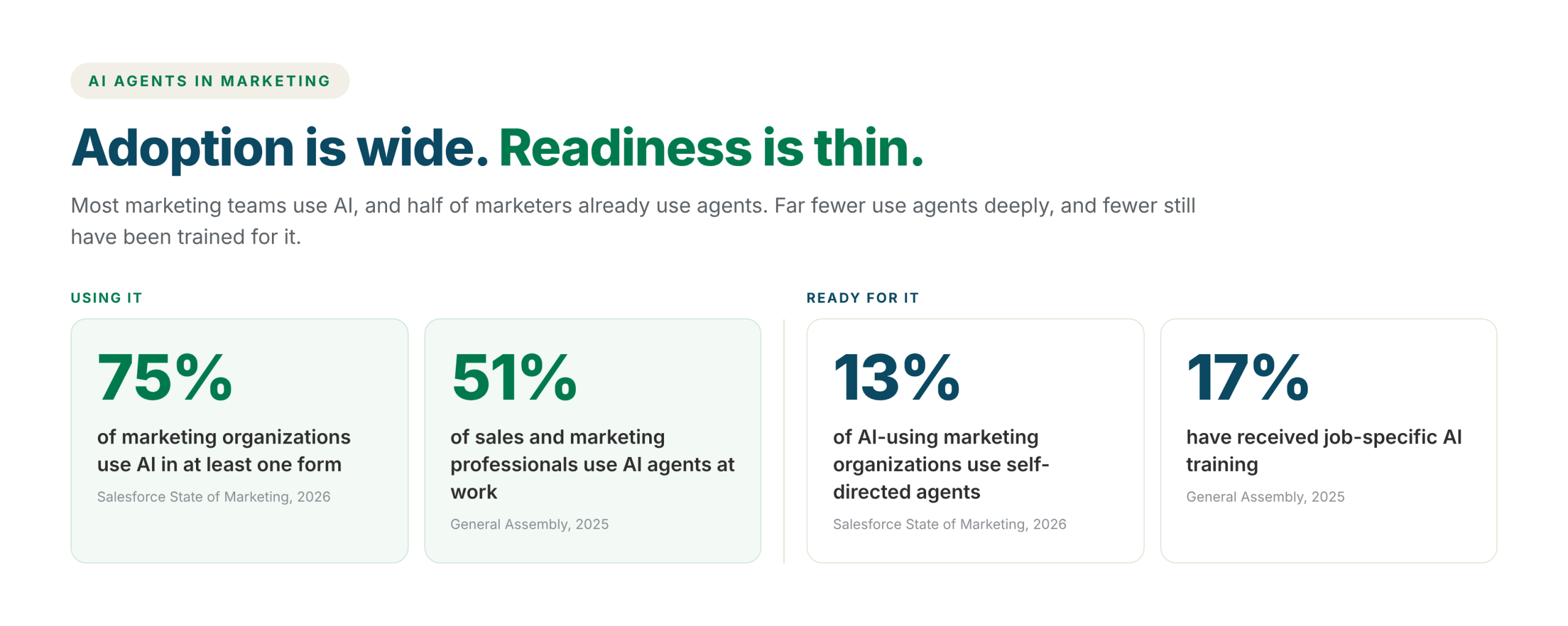
Adoption is broad, but deep use is still rare. Salesforce’s 10th State of Marketing report, based on nearly 4,500 marketers and published in May 2026, found that 75% of marketing organizations use AI in at least one form. Among those using AI, only 13% use self-directed agents, even though marketers expect agents to save them up to eight hours a week.
Use is running ahead of training. A General Assembly survey of more than 300 US and UK sales and marketing professionals found that 51% use AI agents at work, but only 17% have received comprehensive, job-specific AI training. Another 32% have had no formal training at all.
What does it mean for marketers to become builders?
A marketer-builder is someone without an engineering background who uses AI models and agent tools to create their own workflows: plugins, scripts, integrations and small agents that automate repetitive work. A few years ago these projects needed a developer. Now many can be built in an afternoon.
Anthropic’s own growth marketing team is a well-documented example. In a January 2026 case study, a non-technical growth marketer used Claude Code to build a Figma plugin that generates ad variations in one click, in under an hour. Ad creation fell from about 30 minutes to about 30 seconds per ad. Other marketing teams at the company reported similar gains: customer case studies drafted in 30 minutes instead of 2.5 hours, and more than 100 hours a month freed up in influencer marketing. As the marketer put it, “You don’t need to know how to code.”
Large enterprises are moving too, but with structure behind them. When Deloitte made Claude available to more than 470,000 people in October 2025, the rollout came with a dedicated Claude Center of Excellence and a certification program for 15,000 professionals. Microsoft’s 2025 Work Trend Index, based on 31,000 workers in 31 countries, found leaders expect their teams to be training and managing AI agents within five years.
The pattern is worth noticing. The success stories come from teams with time to experiment, deep familiarity with the models, or a dedicated support function. Most marketing teams have none of the three.
Why the builder model is straining marketing teams
Teams are smaller and budgets are flat
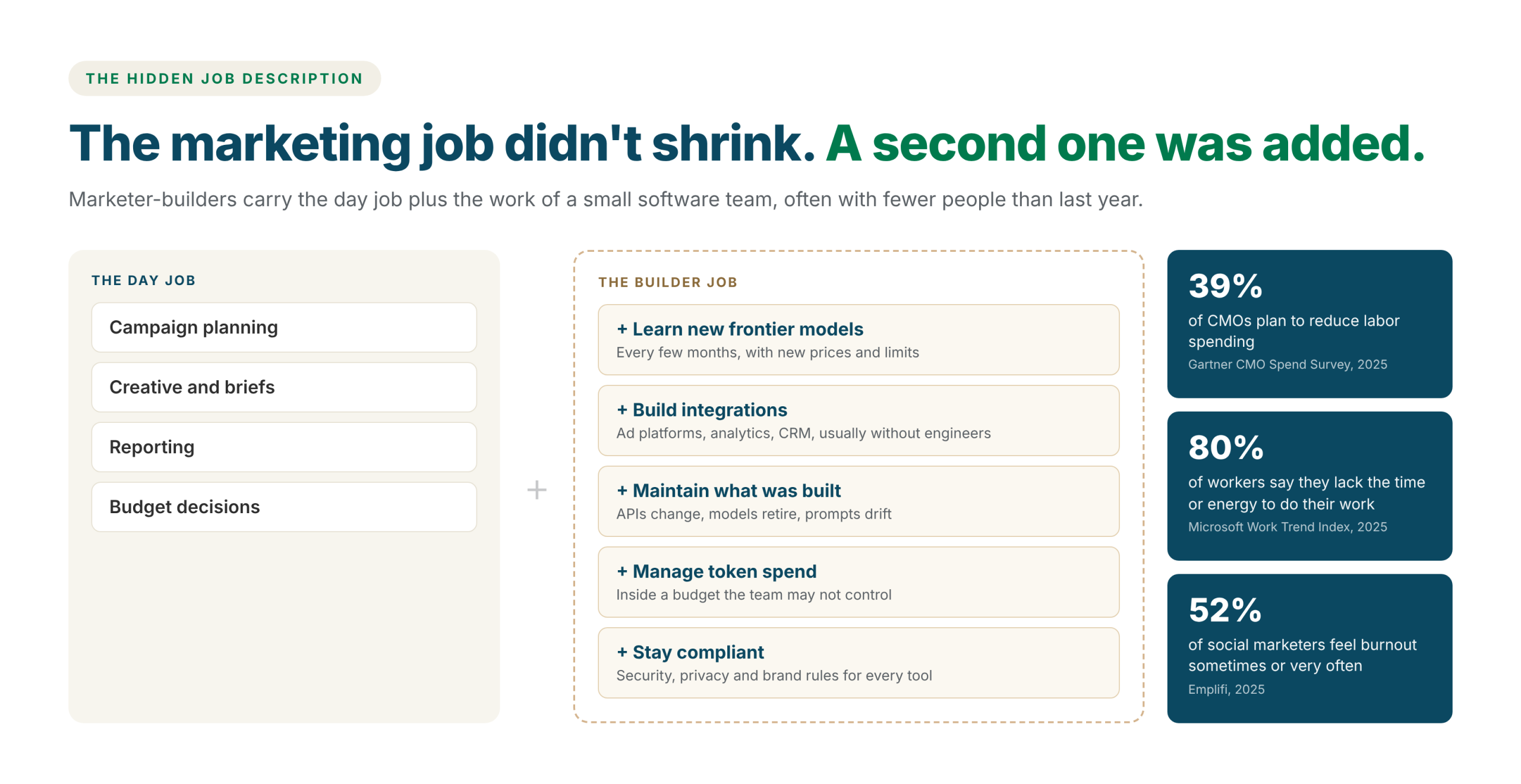
Marketing teams are being asked to build while they are shrinking. Gartner’s 2025 CMO Spend Survey found marketing budgets flat at 7.7% of company revenue, 59% of CMOs saying they lack the budget to execute their strategy, and 39% planning to reduce labor spending, with reducing headcount among the top actions.
Across the wider economy, Challenger, Gray and Christmas reported 477,033 announced US job cuts in the first seven months of 2026, with 112,713 of them attributed to AI, about one in four. The people who remain absorb the work.
People are already stretched
Microsoft’s research found that 80% of the global workforce says it lacks the time or energy to do its work, while 53% of leaders say productivity must increase. In marketing specifically, Emplifi’s State of Social Media Marketing survey of 564 marketers found that 52% feel burnout sometimes or very often, and 57% work on social teams of fewer than six people. In the General Assembly survey, 18% said AI had created more work for them, not less.
Building is only the first job. Maintaining is the second.
The builder expectation quietly adds a second job description on top of the first. Marketers are now expected to:
- Keep up with frontier models that change every few months, each with different strengths, prices and limits.
- Build integrations between ad platforms, analytics, CRM and data warehouses, usually without engineering support.
- Maintain what they built when APIs change, models are retired, prompts drift or the person who built the workflow moves on.
- Manage cost inside a token budget they may not control.
- Stay compliant with security, privacy and brand rules for every tool they create.
None of this is campaign work. Every hour spent fixing a broken integration is an hour not spent on the audience, the message or the budget decisions that actually move revenue.
Tokenmaxxing meets the token cap
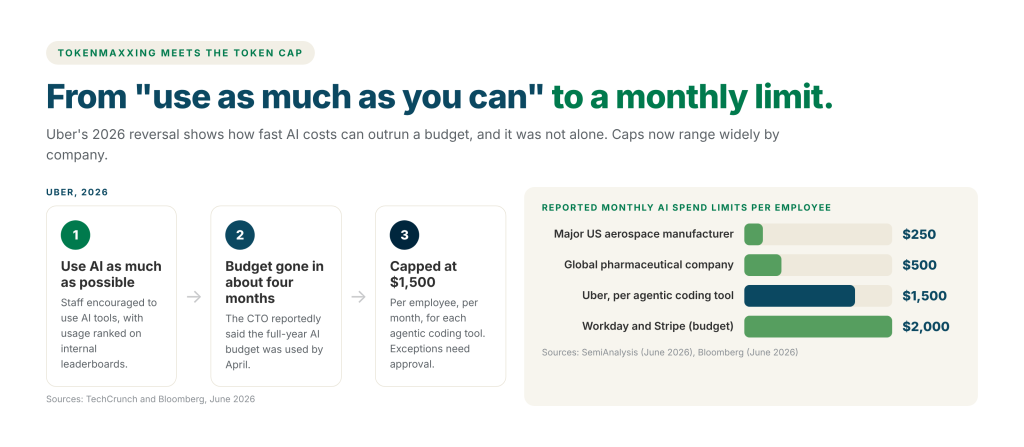
Tokenmaxxing is the practice of pushing employees to use as much AI as possible, often tracked on internal usage leaderboards. In 2026 it collided with the bill.
Uber is the clearest case. The company encouraged staff to use AI tools as much as possible and ranked internal usage on leaderboards. Its CTO then reportedly said the company had used its entire annual AI budget in about four months, according to TechCrunch, citing The Information. In June 2026, Bloomberg reported that Uber had capped spending at $1,500 per employee per month for each agentic coding tool, including Claude Code and Cursor, with exceptions only by approval.
Uber is not alone. The Next Web reported in June 2026 that AT&T has limited some employees’ access to GitHub Copilot, Meta is reining in staff spending on AI tools, and Walmart has capped use of its in-house AI agent, citing reporting from The Information. An industry analysis from SemiAnalysis the same month found monthly per-employee limits ranging from a $250 cap at a major US aerospace manufacturer to budgets of around $2,000 at Workday and Stripe. At the aerospace company, some power users exhausted their monthly allowance in four days.
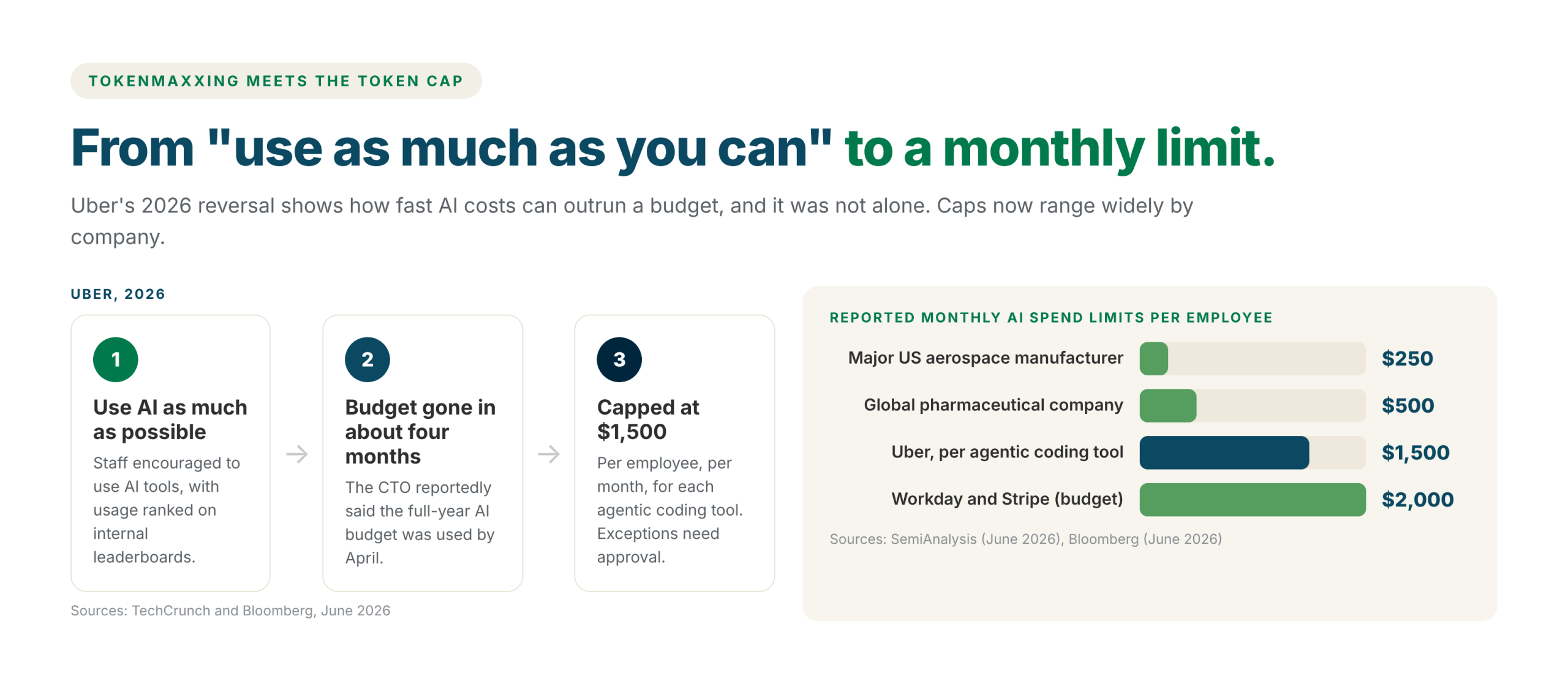
Caps hit marketer-builders especially hard. Agentic workflows that read large data exports, loop through campaigns or generate hundreds of variations burn through tokens quickly. Marketing rarely gets first claim on the AI budget ahead of engineering. And when a cap lands mid-month, the workflow a campaign depends on can simply stop.
Is the marketer-as-builder model scalable?
For individual productivity, yes. As an operating model for a whole marketing function, not on its own. Four problems compound as more people build:
- Knowledge sits with one person. When the builder leaves or changes roles, their workflows often stop working and nobody knows how to fix them.
- Maintenance grows with every tool. Ten marketers each maintaining three workflows is thirty small software projects with no owner.
- Costs are hard to predict. Usage spikes, caps arrive, and the business case changes after the tools are already in use.
- Risk is spread out. Every homemade integration is another place for customer data and brand rules to slip.
Gartner predicts that over 40% of agentic AI projects will be canceled by the end of 2027 because of escalating costs, unclear business value or inadequate risk controls. Those are the same pressures facing do-it-yourself marketing agents.
A more sustainable approach: buy the foundation, build at the edges
The answer is not to stop marketers from building. It is to be deliberate about what they build.
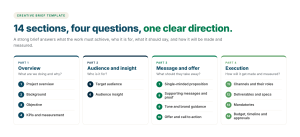
- Use purpose-built, maintained agents for core, recurring decisions. Measurement, budget allocation, planning and briefs happen every month and touch revenue directly. They need connected data, tested models and someone accountable for keeping them running.
- Let marketers build at the edges. One-off tools, experiments and personal productivity workflows are where homemade agents shine, and where a broken script costs little.
- Give builders support. A shared library of approved workflows, a named owner for each one, and basic documentation turn individual hacks into team assets.
- Budget tokens like media. Allocate AI spend to the workflows with the clearest return, and review it on the same rhythm as the rest of the budget.
- Measure outcomes, not usage. Leaderboards reward consumption. Track planning time, acquisition cost and revenue instead.
How Insika fits
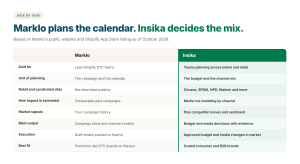
Insika is built to be the maintained foundation, so marketing teams do not have to build and maintain one themselves. It connects to Shopify, Meta Ads, Google Ads, LinkedIn Ads, TikTok Ads, Google Analytics, HubSpot and retail sales data, models what each channel contributes, and recommends decisions your team approves before anything goes live. The integrations, models and upkeep are Insika’s job. Your team’s job is the judgment. GURU Organic Energy used Insika to cut planning cycles by 90% and lift sales by 23%.
To go deeper, read our guides to agentic marketing, AI marketing agents and marketing budget allocation.
Frequently asked questions
What are AI agents in marketing?
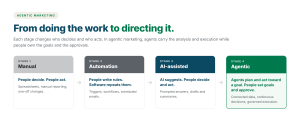
AI agents in marketing are software systems that can pursue a marketing goal across several steps: gathering data, analyzing it, deciding what to do and taking action in marketing tools, usually with a person approving important decisions. Common uses include budget reallocation, ad creation, reporting and campaign monitoring.
How many marketers use AI agents?
About half. A 2025 General Assembly survey found 51% of sales and marketing professionals use AI agents at work. Salesforce’s 2026 State of Marketing report found that among marketing organizations using AI, only 13% use self-directed agents.
What is tokenmaxxing?
Tokenmaxxing is the push for employees to use as much AI as possible, often measured with usage leaderboards. It has led to unexpectedly large AI bills at some companies, which is why several have introduced per-employee token or spending caps.
Why are companies capping AI token usage?
Because costs grew faster than expected. Uber reportedly used its full-year AI budget in about four months before capping spending at $1,500 per employee per month for each agentic coding tool. Other companies have set monthly limits commonly between about $250 and $2,000 per employee.
Should marketers learn to build AI agents?
Learning the basics is valuable, and building small tools for personal productivity is a great place to start. But core, revenue-critical workflows need maintained systems with clear ownership, not tools that depend on one person’s spare time.
Sources
All statistics above link to their original source: Salesforce State of Marketing (10th edition, 2026), General Assembly (2025), Anthropic (2025 and 2026), Microsoft Work Trend Index (2025), Gartner CMO Spend Survey (2025) and agentic AI prediction (2025), Challenger, Gray and Christmas (July 2026 report), Emplifi (2025), TechCrunch, Bloomberg, The Next Web and SemiAnalysis (2026).
Want a marketing agent your team does not have to build or maintain? Watch the Insika demo or talk to our team.