
A good creative brief is the cheapest way to get better creative. It gives designers, writers and media teams one clear objective, one audience and one message to build around, so the work starts in the right place instead of being fixed in round three of feedback.
This page gives you a free creative brief template you can download and use today, a filled-in example, and practical guidance on writing each section well.
What is a creative brief?
A creative brief is a short document that tells a creative team what a piece of work needs to achieve, who it is for, what it should say, and the constraints it must work within. It is written before any concepts are developed, and it becomes the standard the finished work is judged against.
The best briefs are short. One to two pages is enough for most projects. A brief that tries to include everything usually hides the one thing that matters most: the single message the audience should take away.
What to include in a creative brief
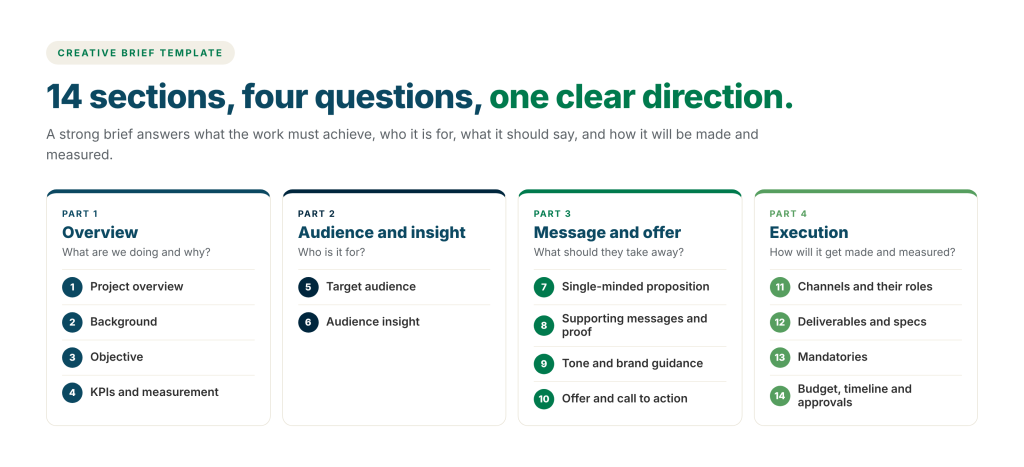
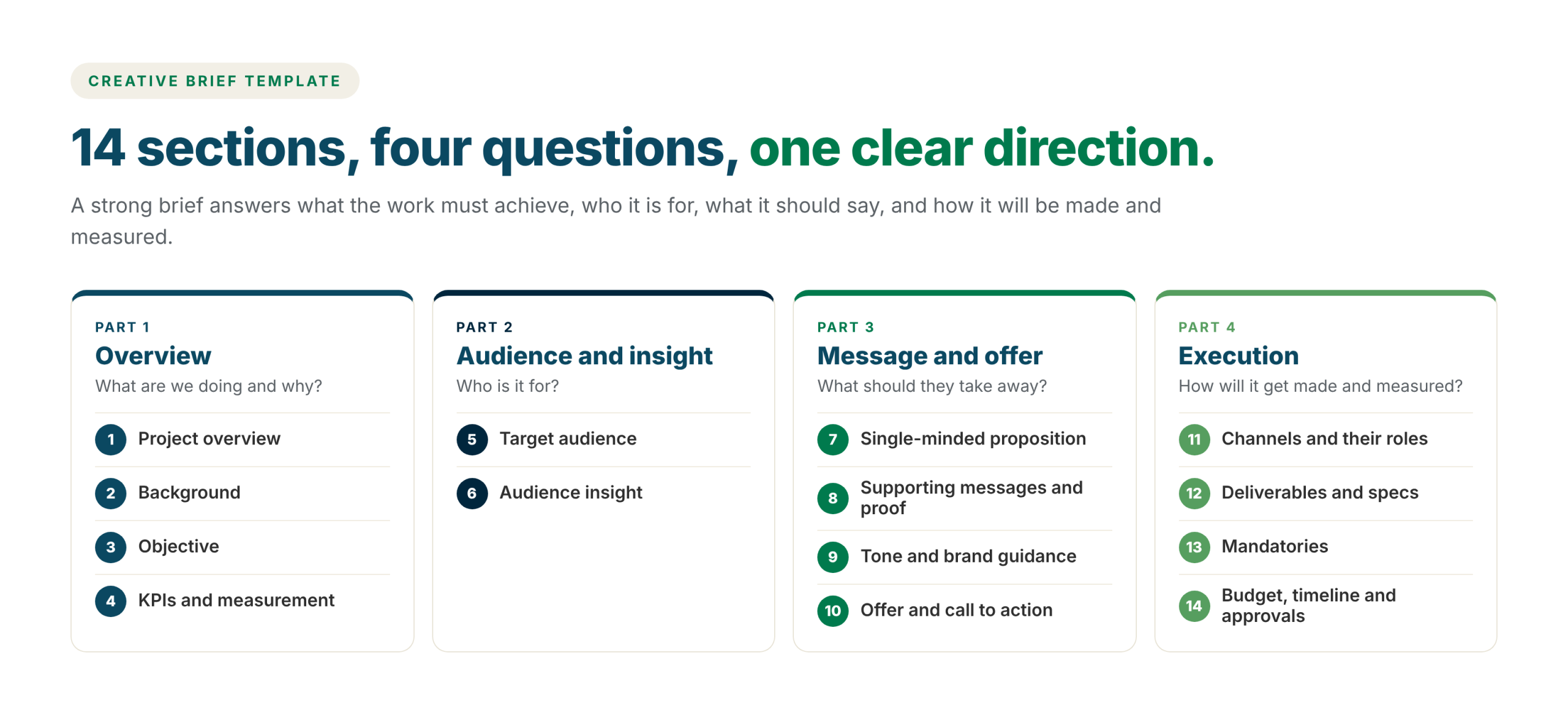
Our template has 14 sections in four parts. Each part answers a different question for the team.
The creative brief template, section by section
Use the prompts below to fill in each section. The downloadable template includes the same prompts.
Part 1: Overview
- Project overview. Project name, owner, key dates and the people who will approve the work.
- Background. Why this project, and why now? What has changed in the market, the product or the results that makes this work necessary?
- Objective. One primary objective, written so you will know whether you achieved it. “Increase trial among first-time buyers” is clearer than “build awareness and drive sales.”
- KPIs and measurement. The metrics that define success, the target for each, and where the data will come from.
Part 2: Audience and insight
- Target audience. One primary audience, described by needs and behavior, not just demographics.
- Audience insight. The truth about this audience that the work can build on: a tension, a frustration or a motivation they would recognize in themselves.
Part 3: Message and offer
- Single-minded proposition. The one thing you want the audience to believe or feel after seeing the work. If you can only write one sentence in the whole brief, write this one.
- Supporting messages and proof points. Up to three reasons to believe the proposition, each backed by evidence.
- Tone and brand guidance. How the work should feel, with examples of what is on brand and what is not.
- Offer and call to action. What you want the audience to do next, and what they get for doing it.
Part 4: Execution and measurement
- Channels and their roles. Where the work will run and what each channel is responsible for, from awareness through to conversion.
- Deliverables and specs. Every asset, with format, dimensions, length, versions and owner.
- Mandatories. Logos, legal lines, claims rules and anything the work must include or avoid.
- Budget, timeline and approvals. Production budget, key milestones, the review process and who signs off.
Creative brief example
Here is the template filled in for a fictional brand, so you can see the level of detail that works.
| Section | Example: Northfield Oat Co. spring launch |
|---|---|
| Background | Northfield is launching a barista oat milk in 400 grocery stores and online. Category shoppers already know oat milk, but most associate it with coffee shops rather than home. |
| Objective | Drive first purchase of the barista edition among existing oat milk buyers in launch stores. |
| KPIs | Trial rate in launch stores, retail sell-through by week, cost per first purchase online. |
| Target audience | Home coffee makers aged 25 to 44 who already buy plant-based milk and own an espresso machine or milk frother. |
| Audience insight | “I spent money on a good machine, but my coffee at home still doesn’t taste like the café.” |
| Single-minded proposition | Café-quality foam, at home. |
| Supporting messages | Made for steaming and frothing; foams in under a minute; same price as standard oat milk. |
| Tone | Warm, specific and practical. Show the foam, not the lifestyle. |
| Offer and CTA | Find it in store, or order online and save on the first carton. |
| Channels | Paid social for awareness, retail media for in-store conversion, search for high-intent shoppers. |
| Deliverables | Six-second and 15-second vertical video, four static social ads, retail media banners, one landing page. |
| Mandatories | Logo lockup, plant-based certification mark, allergen line. |
| Budget and timeline | Production budget set by marketing lead; concepts in two weeks, final assets in five, launch in week eight. |
How to write a creative brief that works
- Choose one objective. A brief with three objectives produces work that does none of them well.
- Describe a real person. “Women 25 to 54” gives a creative team nothing to work with. A behavior, a frustration and a context do.
- Make the proposition single-minded. If it contains the word “and,” it is probably two propositions.
- Prove every claim. Each supporting message needs evidence the team can show, not just say.
- Ground it in data. Past campaign results, customer reviews and search behavior make a brief sharper than opinion does.
- Agree on success before work starts. Settling the KPI up front prevents subjective debates at review.
- Keep it short. If the team cannot remember the proposition after one read, the brief is too long.
Adapting the template by project type
The core of the brief stays the same for every project. What changes is the execution detail each type of work needs.
| Project type | Add or emphasize |
|---|---|
| Landing page | Traffic sources, search or ad intent, page sections, proof points, primary and secondary CTA, SEO and tracking requirements. |
| Digital ads | Platform and placements, hook or angle, formats and sizes, number of variants, test plan, landing page destination. |
| Paid search | Keyword themes and intent, headline and description themes, required extensions, landing page match, mandatory disclaimers. |
| Integrated campaign | Campaign idea, message hierarchy, channel role by funnel stage, deliverable matrix by channel, budget by channel, approval workflow. |
Common creative brief mistakes
- Writing the brief after the concept. A brief that justifies an idea already chosen does not guide the work.
- Listing features instead of a benefit. The audience cares what the product does for them.
- Leaving out what success looks like. Without a KPI, feedback becomes a matter of taste.
- Skipping the insight. Work built on demographics alone tends to look like everyone else’s.
- Treating mandatories as an afterthought. Late legal and brand requirements cause the most expensive revisions.
Write briefs from your data, not from memory
Most briefs are written from what the team remembers about the last campaign. That is why so many repeat old assumptions. The strongest briefs start from evidence: what actually performed, what customers are saying, and what competitors just changed.
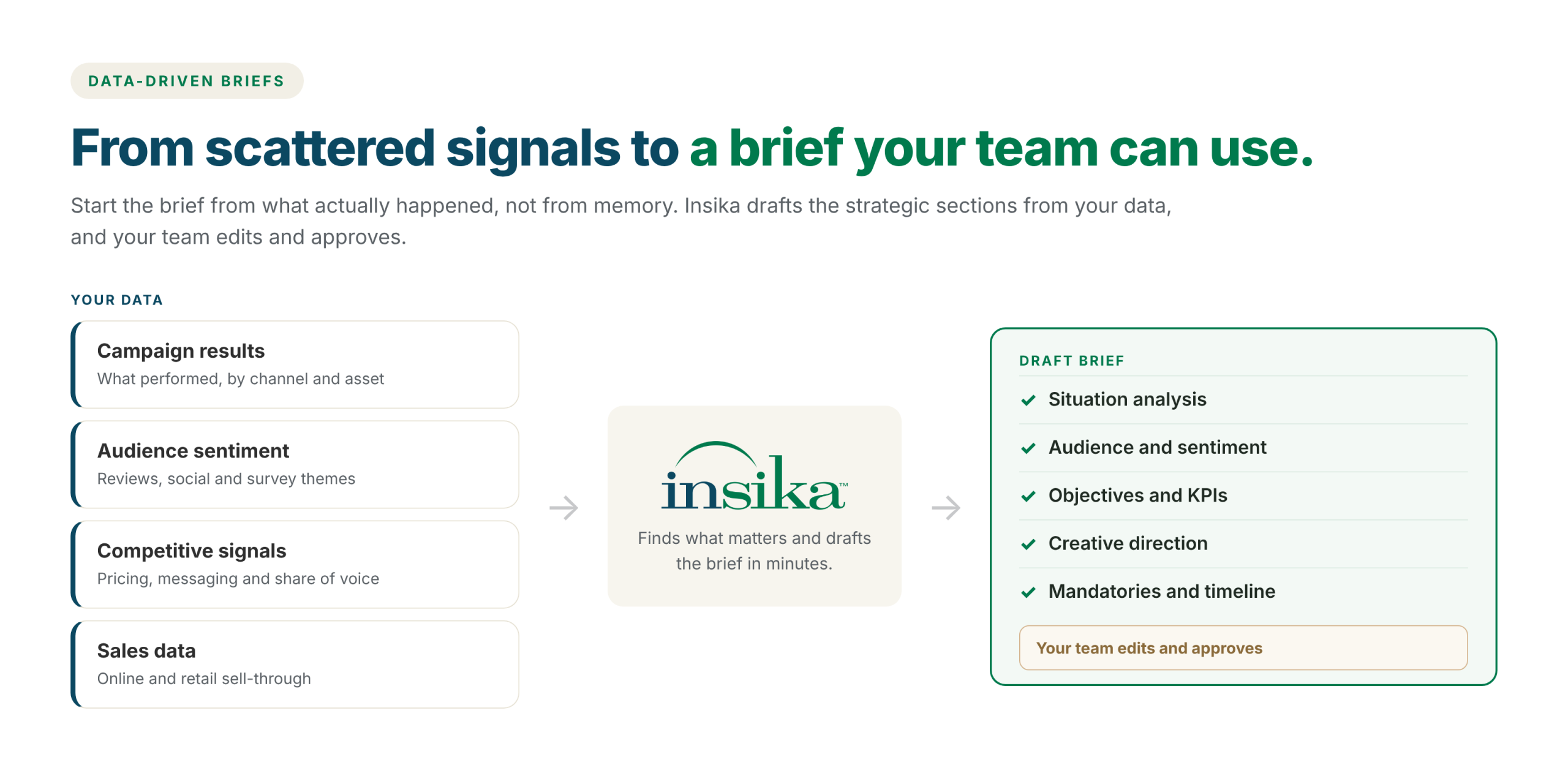
Insika connects your campaign performance, audience sentiment, competitive signals and sales data, then drafts a structured brief with the situation analysis, audience, objectives, KPIs and creative direction already filled in. Your team edits and approves it, so the judgment stays with you and the hours of data gathering do not. To see how Insika supports planning beyond the brief, read our guide to agentic marketing, or try our free ROAS calculator to set the targets your brief will be measured against.
Frequently asked questions
How long should a creative brief be?
One to two pages for most projects. Integrated campaigns may need a longer master brief with short sub-briefs for each channel or asset.
Who writes the creative brief?
Usually the marketer, strategist or account lead who owns the project, with input from whoever holds the data on audience and past performance. The creative team should review it before work starts, so questions surface early.
What is the difference between a creative brief and a project brief?
A project brief covers scope, resources and logistics. A creative brief focuses on the audience, insight and message the work must deliver. Many teams combine both, which is why our template includes budget, timeline and approvals in Part 4.
What is a single-minded proposition?
It is the one idea the work must communicate, written as a short sentence from the audience’s point of view. Every asset in the campaign should express it.
Can I use this template for agency briefs?
Yes. The template works for in-house teams and for briefing agencies and execution partners. A clear brief is the best way to get strong work from any partner.
Want to see a brief built from your own data? Watch the Insika demo or talk to our team.