
Marketing mix modeling software answers the question every CMO gets asked in budget season: what is each channel actually contributing to revenue, and where should the next dollar go? Ad platforms each claim credit for the same sale. Last-click attribution ignores everything that happened before the click. Marketing mix modeling (MMM) takes a different route. It looks at spend and sales over time, across every channel at once, and estimates what each one really drove.
This guide explains how MMM software works, how it compares with attribution and incrementality testing, what to look for when you evaluate tools, and how to turn model output into budget decisions your CFO will sign off on.
What is marketing mix modeling software?
Marketing mix modeling is a statistical method that measures how marketing activity and outside factors affect a business outcome, usually revenue or orders. MMM software automates that work. It pulls in historical data, builds and updates the model, and turns the results into recommendations you can act on.
Because it works from aggregated data rather than tracking individual users, MMM is not affected by cookie loss, consent banners, or walled-garden reporting. That makes it one of the few measurement methods that can put paid social, search, TV, retail media and promotions on the same scale.
How MMM software works
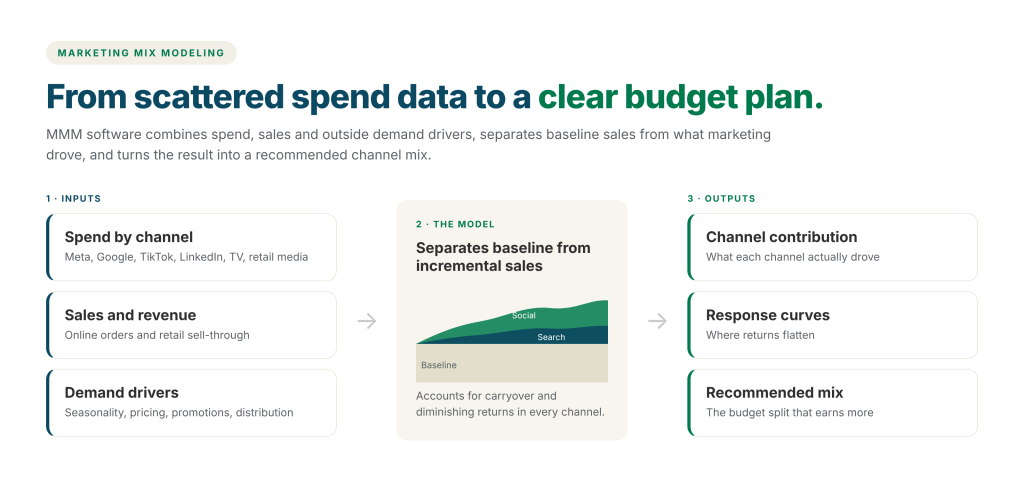
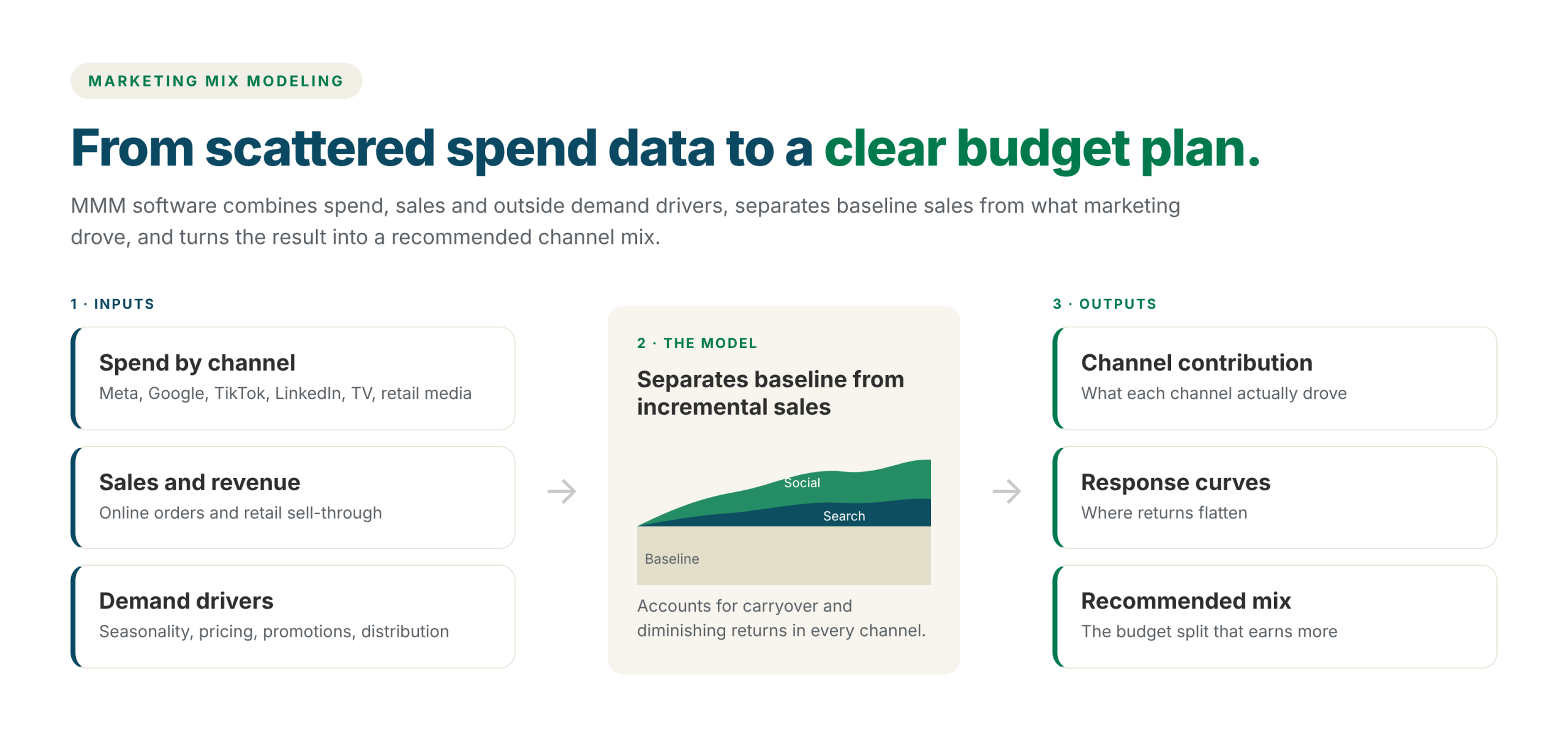
Most MMM tools follow the same three-stage process, even if the methods underneath differ.
1. Bring the inputs together
The model needs weekly or daily spend by channel, sales or revenue, and the factors that move demand on their own: seasonality, pricing, promotions, distribution changes and broader market conditions. For brands sold in stores as well as online, retail sell-through data belongs here too. Leaving it out is one of the most common reasons a model misreads what is working.
2. Estimate each channel’s contribution
The model separates the baseline (sales you would have made anyway) from incremental sales driven by each channel. Good models account for two realities of media: effects carry over for days or weeks after spend, and every channel eventually hits diminishing returns, where each extra dollar produces less than the one before.
3. Turn contribution into a plan
The output that matters is not a chart of past contribution. It is a recommendation: which channels have room to scale, which are saturated, and how a fixed budget should be redistributed to produce more revenue. Our guide to marketing budget allocation covers that step in detail. To see whether your latest spend is still paying back, try our free ROAS calculator.
MMM vs. multi-touch attribution vs. incrementality testing
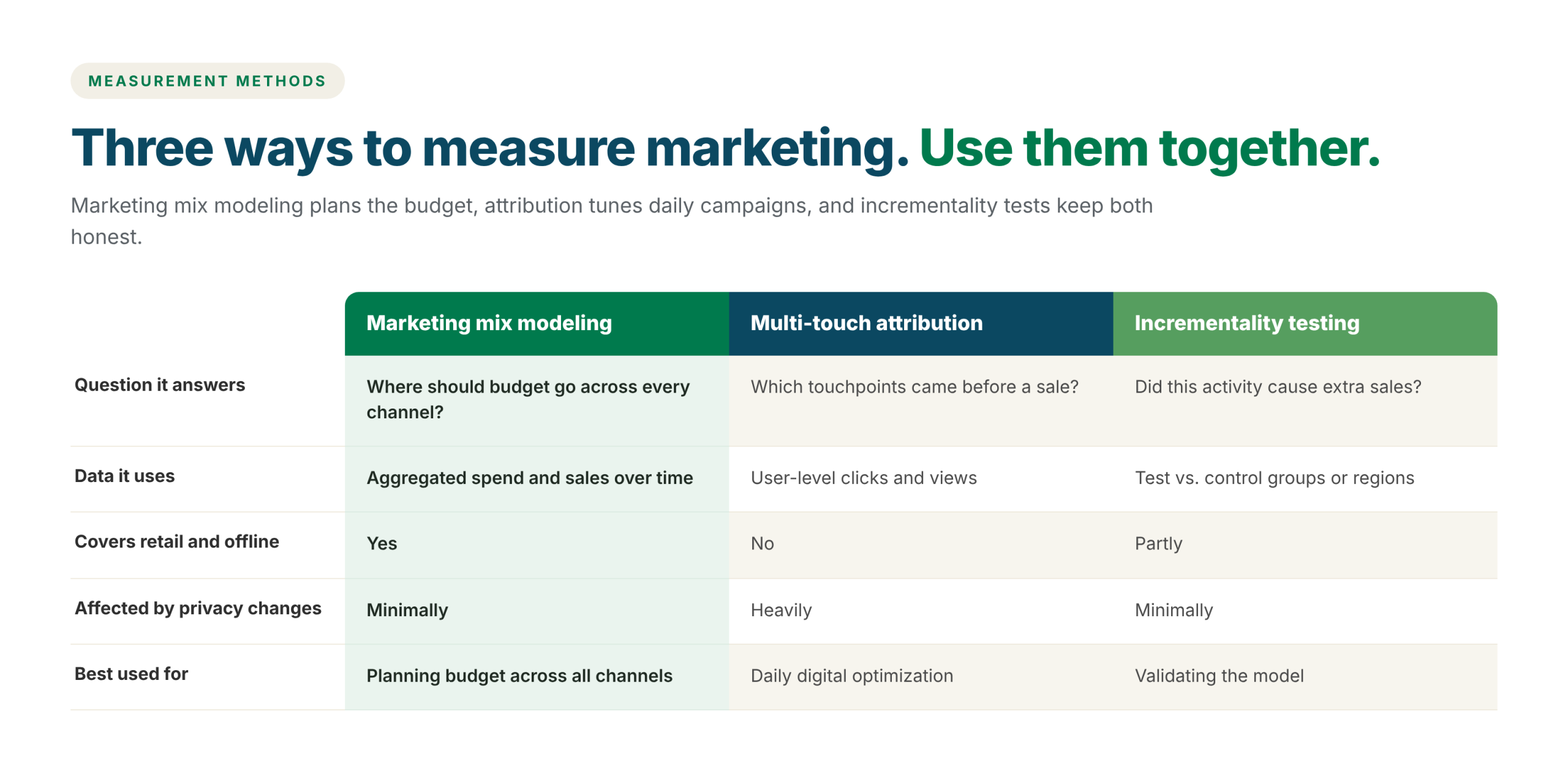
These three methods answer different questions, and the strongest measurement programs use them together rather than picking one.
Read the comparison as text
| Marketing mix modeling | Multi-touch attribution | Incrementality testing | |
|---|---|---|---|
| Question it answers | What did each channel contribute, and where should budget go? | Which touchpoints appeared before a conversion? | Did this specific activity cause additional sales? |
| Data it uses | Aggregated spend and sales over time | User-level click and view paths | Test and control groups or regions |
| Covers offline and retail | Yes | No | Partly, depending on test design |
| Affected by privacy changes | Minimally | Heavily | Minimally |
| Best used for | Budget planning across all channels | Day-to-day digital optimization | Validating and calibrating the model |
If you are new to the method, start with our explainer on how media mix modeling helps marketers, then read our guide to measuring incrementality.
What to look for in marketing mix modeling software
MMM tools range from consultancy-built models delivered twice a year to platforms that refresh continuously. When you compare them, these are the questions that separate useful software from a reporting exercise.
- How fresh is the model? A model refreshed quarterly describes a market that has already moved. Look for weekly or continuous updates.
- Which data sources does it connect to? Native connections to ad platforms, commerce, analytics and CRM remove weeks of manual data work. If you sell through retail, check for syndicated and retailer data as well.
- Does it show uncertainty? Every model estimate has a range. Software that shows confidence intervals is easier to defend in a budget review than one that presents a single number as fact.
- Can it be calibrated with experiments? The best results come from models that take incrementality test results as inputs, so the model and the tests keep each other honest.
- Does it recommend, or only report? Contribution charts are useful. Scenario planning and a recommended budget split are what actually change decisions.
- How long until the first result? Some tools need months of setup. Others produce a first model in days once data is connected.
- Who owns the model and the data? Ask whether you can export results, see the inputs, and keep your history if you switch vendors.
Common MMM mistakes to avoid
- Too little history. Models need enough variation in spend to learn from. If every channel has run at the same level all year, the model has little to separate.
- Missing demand drivers. Leaving out promotions, price changes or retail distribution makes marketing look more or less effective than it was.
- Treating the output as final. A model is a starting point. Validate its biggest recommendations with a test before moving large amounts of budget.
- Running it once a year. A one-time study becomes a slide. A model that updates becomes an operating tool.
How Insika approaches marketing mix modeling
Insika builds media mix modeling into a broader decisioning engine. It connects to Shopify, Meta Ads, Google Ads, LinkedIn Ads, TikTok Ads, Google Analytics and HubSpot, along with retail and syndicated sales data from sources such as Circana, SPINS, NPD and Nielsen. The model runs on that combined data and refreshes as new results arrive, so recommendations reflect the market you are in now.
Instead of stopping at a contribution report, Insika turns the model into recommended budget moves your team reviews and approves, then carries approved changes into market. GURU Organic Energy used this approach to cut planning cycles by 90% and lift sales by 23%. You can see the full system on our Why Insika page.
Frequently asked questions
How much data does marketing mix modeling need?
Most models work best with at least two years of weekly data, though modern tools can produce useful early results with less when spend has varied enough across channels. More variation in spend matters more than more rows of data.
Is MMM only for large brands?
It used to be, because models were built by hand by specialist consultancies. Software has lowered the cost and the time required, so brands spending across several channels can now run MMM continuously.
How often should an MMM be updated?
Weekly or monthly is ideal for brands that change spend often. Quarterly is the minimum for the model to stay relevant to planning decisions.
Can MMM measure retail and offline sales?
Yes. Because it works on aggregated sales data, MMM can include in-store revenue, which user-level attribution cannot. The model needs that retail data connected to measure it.
Want to see marketing mix modeling run on your own data? Watch the Insika demo or talk to our team.