
An AI marketing agent is software that can pursue a marketing goal on its own: it gathers data, decides what to do, and takes action, with a person approving the decisions that matter. That is a step beyond the AI assistants most teams use today, which answer questions or draft copy but wait for a human to do everything else.
This guide explains how AI marketing agents work, how they differ from assistants and automation, where they deliver the most value, and how to adopt one without losing control of your brand or your budget.
What is an AI marketing agent?
An AI marketing agent combines three capabilities: access to your marketing data, the ability to reason about that data toward a goal, and permission to take actions in your marketing systems. Give it a goal such as “lower acquisition cost without losing volume,” and it can find where spend is underperforming, propose a fix, and, once approved, make the change.
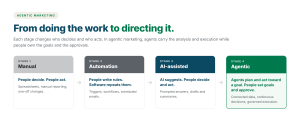
AI assistant vs. automation vs. AI agent
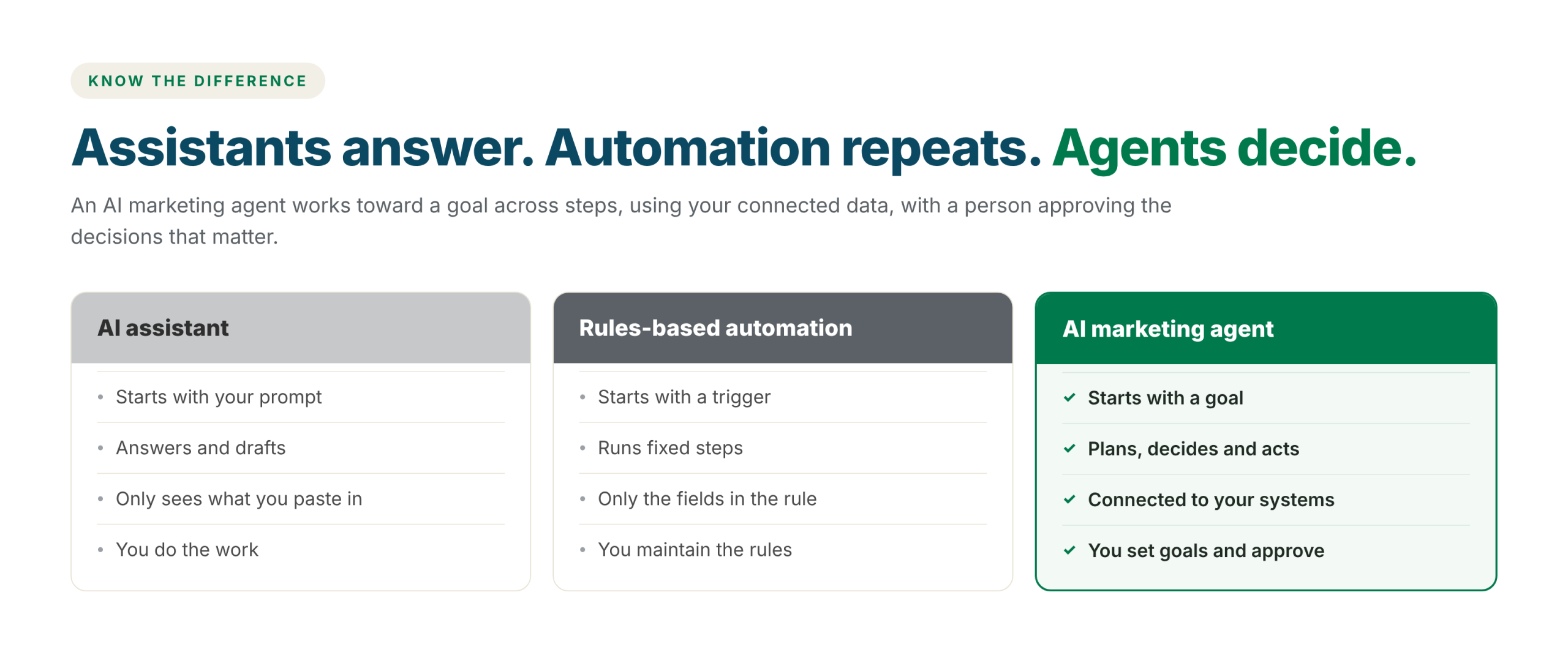
The terms get used interchangeably, but they describe different tools.
Read the comparison as text
| AI assistant | Rules-based automation | AI marketing agent | |
|---|---|---|---|
| What starts it | A person’s prompt | A trigger you defined | A goal you set |
| What it does | Answers and drafts | Runs the same steps every time | Plans, decides and acts across steps |
| Uses your data | Only what you paste in | Only the fields in the rule | Connected systems, continuously |
| Adapts | No memory between sessions | Only when someone edits the rule | Learns from results |
| Human role | Does the work | Maintains the rules | Sets goals and approves decisions |
How an AI marketing agent works
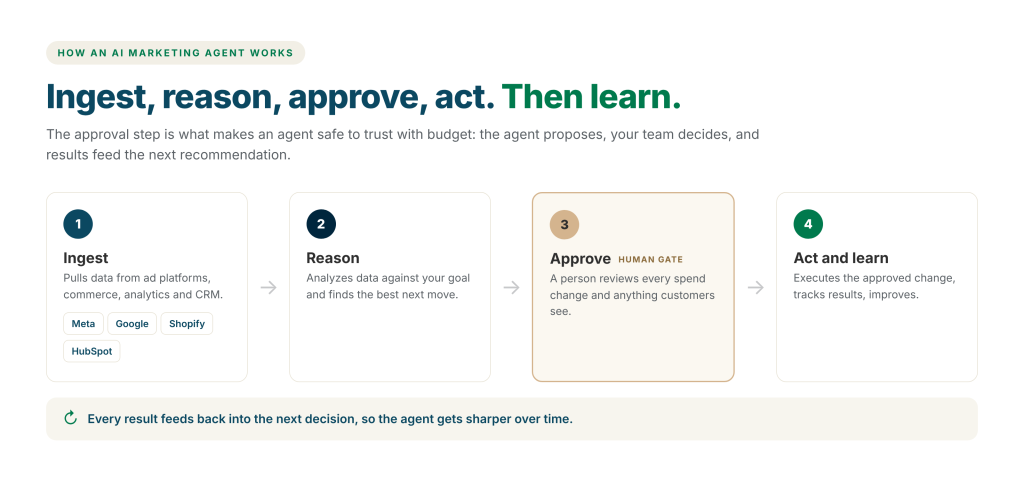
Most agents run a continuous loop with four stages. The stage that separates a trustworthy agent from a risky one is the approval step.
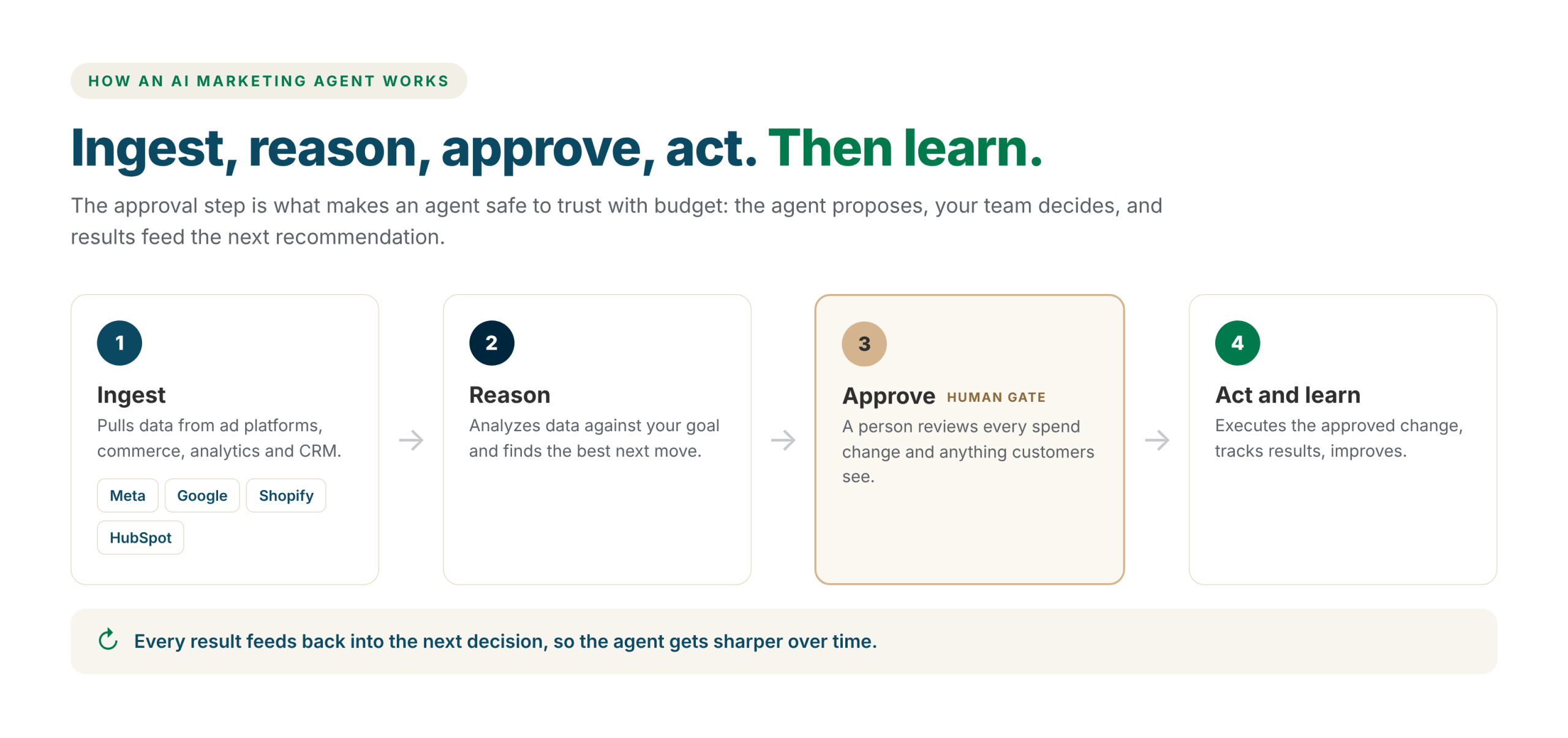
- Ingest. The agent pulls data from ad platforms, commerce, analytics and CRM, so it works from your actual performance rather than general knowledge.
- Reason. It analyzes the data against your goal and identifies the best next move, with the evidence behind it.
- Approve. A person reviews the recommendation. Spend changes and anything customers will see should always pass through this gate.
- Act and learn. The agent carries the approved change into market, tracks the result, and feeds what it learns into the next decision.
Where AI marketing agents add the most value
- Budget reallocation. Shifting spend between channels and campaigns based on where the next dollar performs best. See our guide to marketing budget allocation.
- Performance monitoring. Watching for drops in efficiency, competitor moves and sentiment shifts, and flagging them before the weekly report would.
- Planning and briefs. Turning performance data into media plans and creative briefs in hours rather than weeks.
- Execution. Carrying approved changes into ad platforms without manual rebuilds.
Risks to manage, and the guardrails that handle them
- Made-up numbers. A general language model can produce confident figures that are not real. Agents should ground every recommendation in your actual data and show where the numbers came from.
- Uncontrolled spend. Set approval thresholds so no budget change above a set amount goes live without a named approver.
- Brand risk. Keep anything customer-facing behind human review.
- Data access. Check how the vendor secures your data and whether it is used to train models for other customers.
How to evaluate an AI marketing agent
- Which of your systems does it connect to, and how deeply?
- Can it explain every recommendation with the data behind it?
- Where are the approval gates, and can you set your own thresholds?
- Does it learn from results, or start over each time?
- Is it measured on business outcomes such as revenue and acquisition cost, or just on tasks completed?
For a wider view of the tool landscape, see our guide to the best AI marketing tools for CMOs.
How Insika works as an AI marketing agent
Insika follows an Ingest, Reason, Act model. It connects to Shopify, Meta Ads, Google Ads, LinkedIn Ads, TikTok Ads, Google Analytics, HubSpot and retail sales data, reasons over it with statistical models grounded in your numbers, and recommends decisions your team approves before anything goes live. Results feed back in, so each recommendation learns from the last. We call this role the Agent of Record: the system that owns the path from data to decision to execution.
Read more about decisioning engines or see how Insika compares with general-purpose models on our Why Insika page.
Frequently asked questions
Will an AI marketing agent replace my marketing team?
No. It replaces the manual work of pulling, reconciling and reformatting data. Strategy, brand judgment and final approval stay with your team.
Is an AI marketing agent the same as ChatGPT?
No. General assistants are excellent at reasoning and writing, but they do not connect to your data continuously, remember results, or take action in your systems. Many agents are built on top of those models and add the data, statistics and execution layers.
How long does it take to set up?
It depends on how many systems you connect. Most of the effort is connecting data sources and agreeing on approval rules, not configuring the agent itself.
See an AI marketing agent working on real data: watch the Insika demo or talk to our team.