
Triple Whale is one of the best-known analytics platforms for Shopify brands, and for many direct-to-consumer teams it is the right choice. But brands searching for a Triple Whale alternative usually share one of a few needs: they sell in retail as well as online, they want decisions rather than dashboards, or they need to plan budget across channels the pixel cannot see. This guide compares the two honestly so you can tell which one fits.
What Triple Whale does well
Triple Whale is built around Shopify and ecommerce measurement. Its core is a first-party tracking pixel paired with several attribution models, real-time dashboards, and profit and lifetime value reporting. Its Moby AI tools answer questions about store data and suggest what to scale or cut, and its enterprise tier combines multi-touch attribution, media mix modeling and incrementality testing. For a Shopify-first brand that wants a daily view of ad performance in one place, it is a strong product.
Why brands look for a Triple Whale alternative
- Retail and offline sales. Pixel-based tools see online journeys. Brands that also sell through grocery, specialty or big-box retail need store sales in the same view, and in-store data does not flow into pixel-based platforms automatically.
- Decisions, not dashboards. Many teams already have more reporting than they can act on. What they lack is a clear recommendation and a way to carry it out.
- Channels beyond the click. Planning that includes B2B channels such as LinkedIn, or CRM data from HubSpot, goes beyond a Shopify-centered view.
- Cost that scales with revenue. Pricing tied to store revenue can grow faster than the value a team gets from additional dashboards.
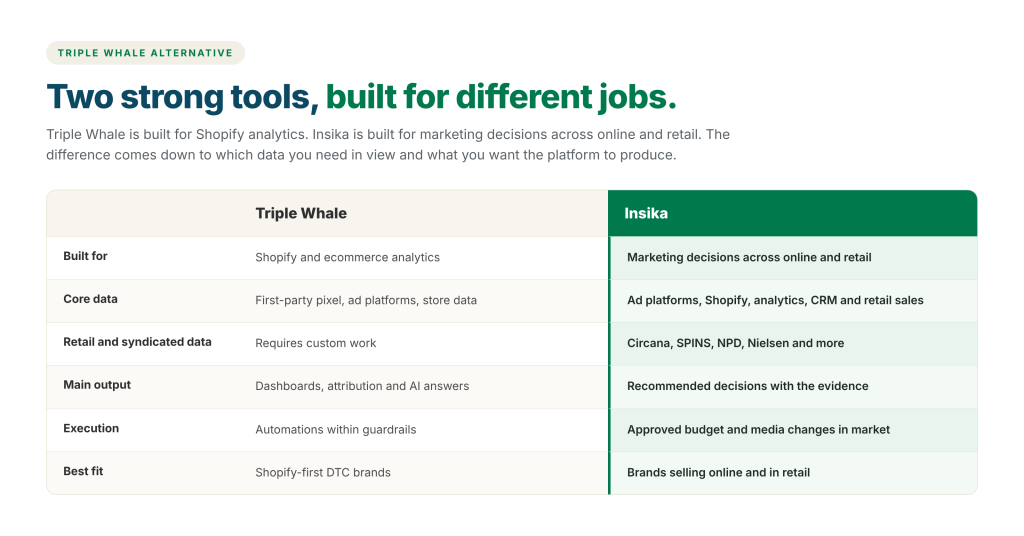
Insika vs. Triple Whale, side by side
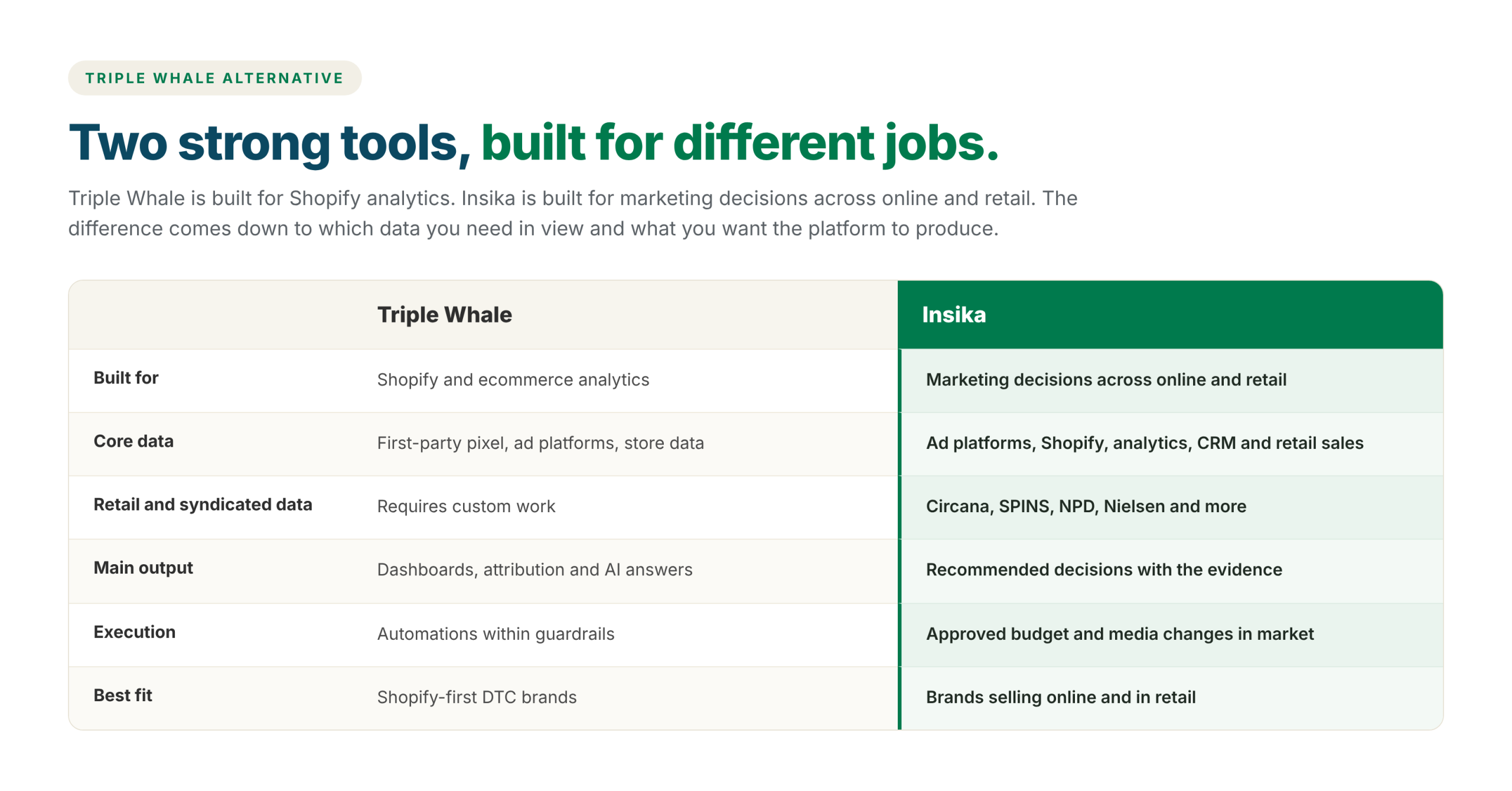
Read the comparison as text
| Triple Whale | Insika | |
|---|---|---|
| Built for | Shopify and ecommerce analytics | Marketing decisions across online and retail |
| Core data | First-party pixel, ad platforms, store data | Ad platforms, Shopify, analytics, CRM and retail sales data |
| Retail and syndicated data | Requires custom work | Connects to sources such as Circana, SPINS, NPD and Nielsen |
| Main output | Dashboards, attribution and AI answers | Recommended decisions with the evidence behind them |
| Execution | Automations and agent actions within guardrails | Approved budget and media changes carried into market |
| Best fit | Shopify-first DTC brands that want daily performance visibility | Scaled consumer brands that sell online and in retail and need cross-channel planning |
Which one is right for you?
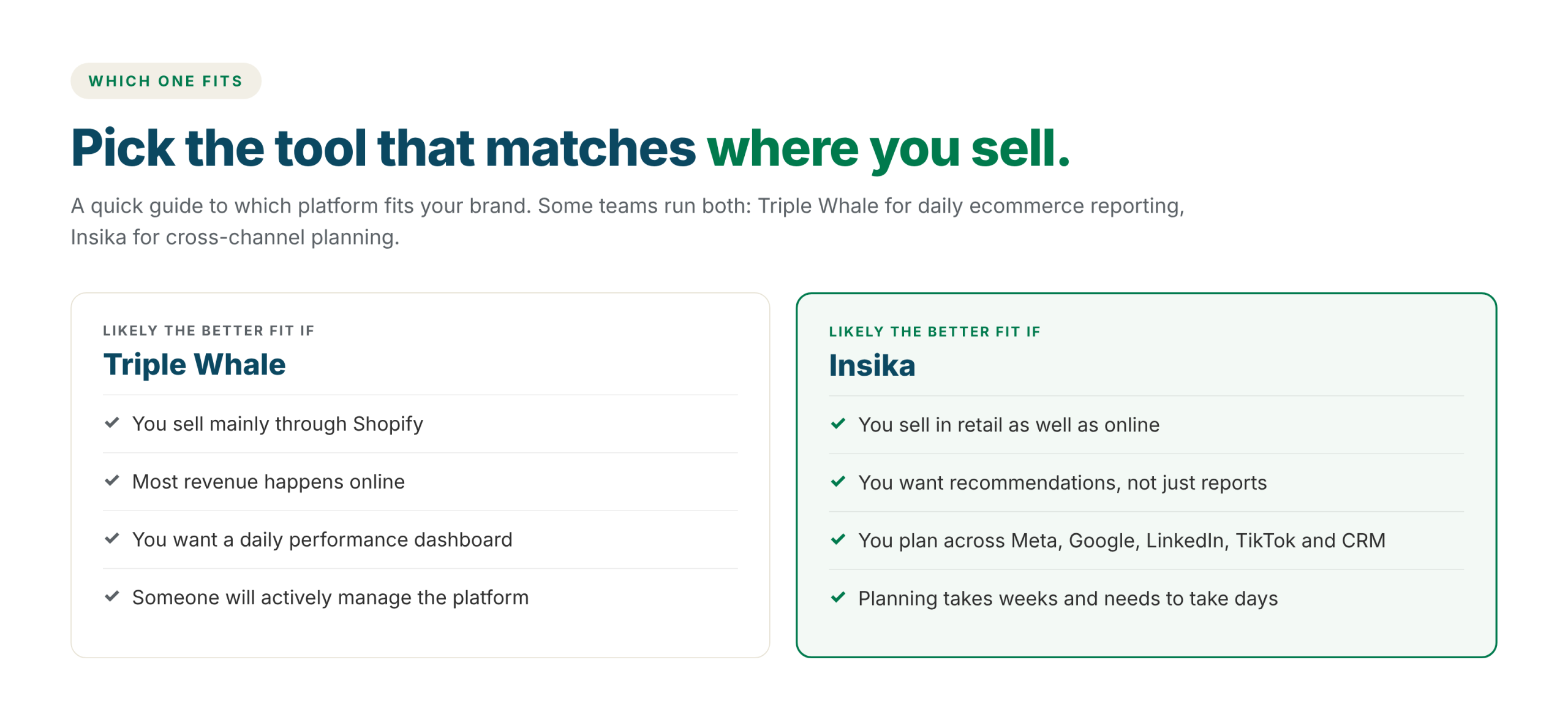
Triple Whale is likely the better fit if
- You sell mainly through Shopify and most revenue happens online.
- Your team wants a daily dashboard of ad and profit performance.
- Someone on the team will actively manage the platform and act on its reports.
Insika is likely the better fit if
- You sell in retail as well as online and need both in one view.
- You want recommendations on where budget should go, not just what happened.
- You plan across Meta, Google, LinkedIn, TikTok and CRM, not only Shopify-driven channels.
- Planning cycles take weeks and you need them to take days.
Some brands use both: Triple Whale for daily ecommerce reporting, and Insika for cross-channel planning and budget decisions.
What switching looks like
- Connect your data. Ad platforms, Shopify, analytics, CRM and any retail data sources.
- Set your baseline. Record current planning time, return on media spend and acquisition cost.
- Review the first recommendations. Start with one decision, such as next month’s channel mix, and approve the changes you agree with.
- Measure against the baseline. Expand once results are verified.
Brands using this approach have seen strong results. GURU Organic Energy cut planning cycles by 90% and lifted sales by 23%, and ColorTokens reached market 75% faster with a 12% increase in leads.
Frequently asked questions
Does Insika replace attribution?
Insika uses media mix modeling to measure each channel’s contribution across online and retail, which does not depend on user-level tracking. Teams that rely on click-level attribution for daily optimization can keep it alongside Insika.
Does Insika work with Shopify?
Yes. Shopify is one of Insika’s live integrations, alongside Meta Ads, Google Ads, LinkedIn Ads, TikTok Ads, Google Analytics and HubSpot.
Can I try Insika on my own data?
Yes. Talk to our team about a walkthrough using your channels.
Comparing other options? Read Insika vs. Okara and our guide to marketing mix modeling software, or watch the Insika demo.